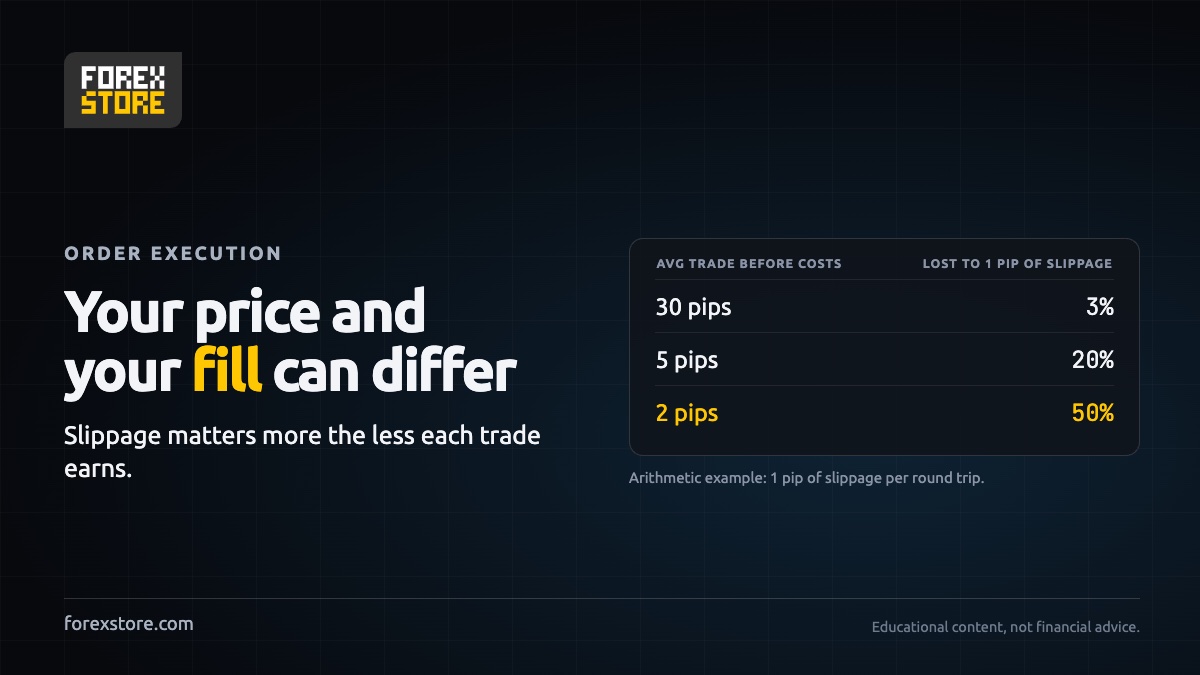
Slippage is the difference between the price you requested and the price you actually got. It comes from the time an order needs to reach the market and from how much liquidity is available at that moment. It is a normal cost of trading, but it matters far more to a scalper or an expert advisor (EA) earning 2 pips per trade than to a strategy earning 30.
Below we cover how slippage works, the execution types in MetaTrader, which orders can slip, what happens around news, why short-term strategies feel it most, and how to measure it on your own account. The examples use EUR/USD at 0.10 lot, where 1 pip is worth about $1.
What Slippage Is
Say the quote is bid 1.08500 / ask 1.08512 and you press BUY. Between your click and the fill, the price can move:
| Requested | Filled | Slippage | Cost at 0.10 lot |
|---|---|---|---|
| 1.08512 | 1.08522 | 1 pip worse | −$1 |
| 1.08512 | 1.08512 | none | $0 |
| 1.08512 | 1.08507 | 0.5 pip better | +$0.50 |
So slippage can go in either direction. Whether you also receive the better fills depends on how your broker executes orders: in MetaTrader, the execution prices of all trade operations are defined by the broker.
Slippage is not the same as the spread. The spread is the visible gap between bid and ask, and you see it before you trade. Slippage only appears after the fill.
Execution Types in MetaTrader
The broker sets the execution mode for each symbol. You can see it in the Type field of the order window. Each mode handles a price change differently:
| Mode | How it works | If the price moves |
|---|---|---|
| Instant Execution | The order goes out with the current price | Filled within your deviation setting, otherwise a requote |
| Request Execution | You request a price first, then confirm or reject it | The quote is valid for a few seconds only |
| Market Execution | The broker decides the price without further discussion | You get the broker's price: no requote, but it can slip |
| Exchange Execution (MT5) | The order goes to an external trading system | The fill depends on the order book |
A requote means the broker returns a new price and you decide whether to accept it. Deviation is the difference from your price that you agree to in advance: within it, the order fills at the new price with no notice.
Market Execution is worth a closer look, because many accounts use it. MetaTrader's help says that sending such an order means advance consent to its execution at the broker's price. For EAs there is a practical consequence: in the MQL5 documentation, a price and a deviation are required fields for an Instant Execution order but not for a Market Execution one. So don't assume the slippage setting in an EA protects you: check the execution mode of your symbol first.
Which Orders Can Slip
| Order | Fills at | The trade-off |
|---|---|---|
| Market | The current price | Executes now, the price can differ |
| Limit | Your price or better | No slippage, but it may not fill |
| Stop | Your price or worse | Becomes a market order and fills with slippage in a fast move |
| Stop limit (MT5) | Places a limit order at the trigger | Limits slippage, but it may not fill |
The row that matters most is the stop. A stop loss is a trigger, not a promised price. It starts the closing of a trade when the price reaches the level, and the trade then closes at the next available price.
Example on a $2,000 account: SELL 0.10 lot of EUR/USD at 1.08500, stop loss at 1.08700. The plan is −20 pips, or −$20, 1% of the account. If a fast market fills the stop at 1.08750, the result is −25 pips, −$25, or 1.25%. Over a weekend gap the difference can be larger, because the market may open beyond your stop.
A sell closes at the ask, so spread widening can also trigger its stop before the bid line on the chart gets there (see Short Selling in Forex). This is why risk planning has to leave room for a worse fill: see Money Management in Forex.
Why News Makes It Worse
Around major releases such as interest rate decisions, prices move quickly and fewer orders sit near the current price. Spreads tend to widen, and orders can slip, stops included. The same risk appears around rollover and at the weekend open, when the market is thin.
Not every bad fill points to a broker trick, but it is fair to ask how yours handles orders. One term you will meet is last look. The FX Global Code, a set of good-practice principles for the wholesale FX market, defines it as a final opportunity for a market participant to accept or reject a trade request against its quoted price. Principle 17 says firms using it should be transparent about it, and that it should not be used to gather information with no intention of accepting the trade. Principle 10 calls for fair handling of orders and names trading designed to move the market to a client's stop level as unacceptable.
The Code doesn't impose legal obligations, and it doesn't treat the retail public as market participants, so it is no substitute for your broker's own terms. Still, it gives you the right questions: how are orders executed, are they ever rejected, and are better fills passed on?
Why Scalpers and EAs Feel It Most
The same slippage takes a very different share of different strategies. Here is what 1 pip per round trip costs (simple arithmetic):
| Average trade before costs | After 1 pip of slippage | Share lost |
|---|---|---|
| 30 pips | 29 pips | about 3% |
| 5 pips | 4 pips | 20% |
| 2 pips | 1 pip | 50% |
Now take the example from our guide on how to read Myfxbook statistics: 60% wins, +$50 and −$60, profit factor 1.25. At 0.10 lot of EUR/USD that means +50 and −60 pips. A scalper with the same win rate and the same profit factor might make +5 and −6 pips. Add 1 pip of slippage to every trade:
| Illustrative system | Before | After 1 pip |
|---|---|---|
| +50 / −60 pips | PF 1.25, +6 pips per trade | PF 1.20, +5 pips per trade |
| +5 / −6 pips | PF 1.25, +0.6 pips per trade | PF 0.86, −0.4 pips per trade |
The statistics look identical at first, yet one system loses a sixth of its edge and the other loses all of it. EAs add two more factors. They place many trades, so a small cost repeats: 1 pip on 1,000 trades at 0.10 lot is about $1,000. And many of them trigger at the same kind of moment, on breakouts and fast moves, which is when fills tend to be worst.
This is also why live results and backtests differ. The MT5 Strategy Tester can add delays to imitate real conditions: with Random Delay, an order waits 0 to 8 seconds in 90% of cases and 9 to 18 seconds in the rest. That is useful, but it models time, not how much liquidity was really there. If a strategy only survives with no delay, take that as a warning.
How to Measure Slippage on Your Account
Averages quoted by others tell you little, because fills depend on your broker, your hours and your order size. Your own numbers are better:
- Log it. For each trade record the requested price, the filled price and the hour. Many EAs can write this to a log, or you can use a simple sheet.
- Check your stops. In MT4 the Account History tab can show the S/L level next to the closing price, so the slip is visible trade by trade.
- Use one sign rule. For a buy, slippage is filled minus requested. For a sell, it is requested minus filled. A positive number means a worse price.
- Group it. Compare average slippage by hour and around news, not only overall.
- Compare with the edge. Divide average slippage by the average trade in pips. That share is what the table above shows.
If you run an EA, also compare your fills with its live record. A result built at one broker won't transfer exactly to another. This is one more reason to read a robot's average trade in pips before anything else.
How to Reduce It
- Choose the broker carefully. Test execution with small size first. Our guide on how to choose a broker covers what to look at.
- Know the calendar. Avoid opening new trades just before big releases, or use an EA with a news filter if its strategy allows. Check the product page for this.
- Use limit orders where they fit. You avoid slippage on entry, and you accept that some trades will be missed.
- Reduce the distance to the server. A VPS near your broker's server can cut the delay between an EA and the broker. It doesn't add liquidity, so it can't remove slippage.
- Size for the worse case. Plan the risk so that a stop filled a few pips late doesn't break your limits.
- Prefer an edge that can absorb costs. When you compare robots on our top forex robots list or in the full EA catalog, a larger average trade leaves more room for execution costs.
FAQ
What is slippage in forex?
Slippage is the difference between the price you requested and the price you got. It happens because the price can move before an order is filled, and because liquidity at the requested price can be limited. It can be negative or positive.
Does a stop loss guarantee my exit price?
No. A stop loss is a trigger: when the price reaches the level, the position is closed at the next available price. In a fast market or over a weekend gap, the fill can be worse than the stop level, so a planned loss of $20 can become $25 or more.
Is slippage a sign of a bad broker?
Not by itself, because some slippage is normal in fast markets. Look at the pattern in your own log. If slippage is almost always against you, even in calm hours, ask the broker how orders are executed and whether better fills are passed on.
Does a VPS stop slippage?
No. A VPS can reduce the delay between an EA and the broker's server, which helps a latency-sensitive strategy. It doesn't change the liquidity available in the market, so orders can still slip, especially around news.
The Bottom Line
- Slippage is the gap between the requested price and the filled price, and it can go either way.
- Your broker sets the execution mode: Instant Execution can return a requote, Market Execution uses the broker's price.
- Limit orders don't slip but can miss. Stops fill but can slip.
- Spreads and slippage tend to grow around news, so a stop is a trigger, not a promise.
- 1 pip takes about 3% of a 30-pip trade and 50% of a 2-pip trade, so measure it on your own account.
Just getting started? Read our step-by-step guide to start trading.
This article is educational and is not investment advice. The examples are illustrative. Trading leveraged products involves risk of loss.