The spread in forex is the difference between the ask price (where you buy) and the bid price (where you sell). If EUR/USD is quoted at 1.08500 / 1.08512, the spread is 1.2 pips, and on 0.10 lot that costs about $1.20. You pay it once per trade: a buy opens at the ask and closes at the bid, so every trade starts slightly in the red.
Below we cover how to read and calculate the spread, what it costs on different position sizes, fixed and floating spreads, when spreads widen, and how to compare the real cost of two accounts. The examples use EUR/USD on a USD account, the same numbers as in our other beginner articles.
What Is the Spread in Forex?
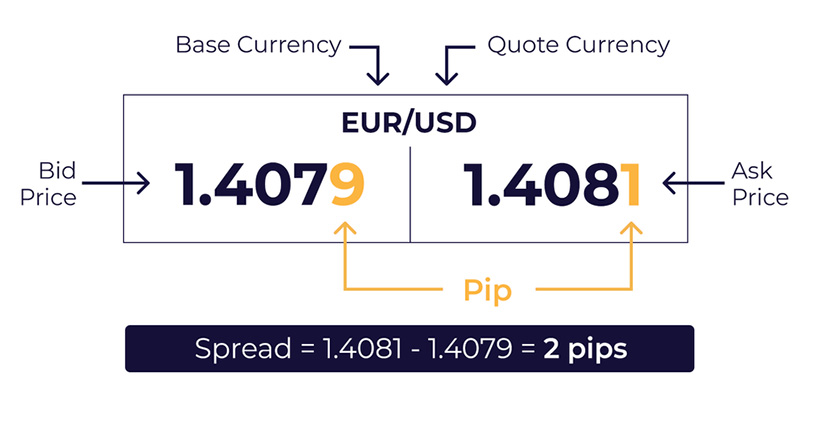
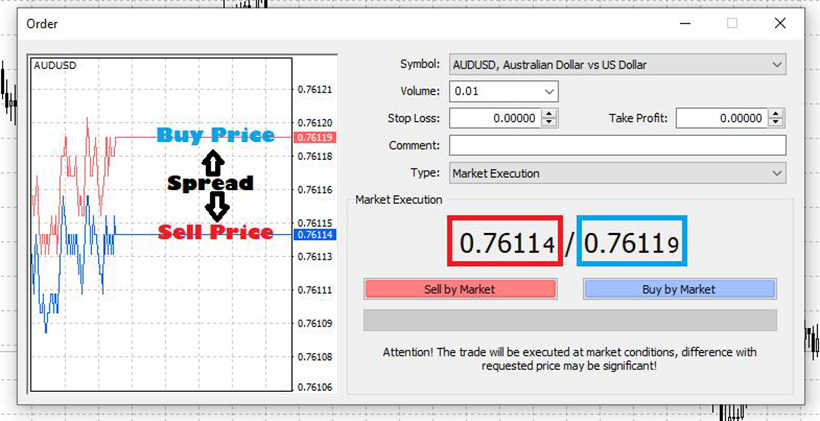
Every quote has two prices. The bid is the price at which you can sell, and the ask is the price at which you can buy. The ask is higher, and the gap between them is the spread. The market price sits roughly in the middle.
The spread is a trading cost, but it isn't always the whole of what you pay or all that your broker earns. Some accounts add a commission, and depending on how a broker works, part of the spread can go to the banks and other providers that supply its prices. That's why two accounts with the same broker can show different spreads for the same pair.
How to Calculate the Spread
Subtract the bid from the ask, then express the result in pips:
Spread = ask − bid
On most pairs 1 pip is 0.0001, and on yen pairs it is 0.01:
| Pair | Bid / ask | Difference | Spread |
|---|---|---|---|
| EUR/USD | 1.08500 / 1.08512 | 0.00012 | 1.2 pips |
| GBP/USD | 1.30850 / 1.30870 | 0.00020 | 2.0 pips |
| USD/JPY | 150.000 / 150.020 | 0.020 | 2.0 pips |
One thing confuses many beginners. MetaTrader shows the spread in points, not pips, and on a 5-digit quote a point is a tenth of a pip. So a spread of 12 in MetaTrader means 1.2 pips, not 12 pips. More in What Is a Pip in Forex?
What the Spread Costs in Money
To turn pips into money, multiply by the pip value and your size:
Spread cost = spread in pips × pip value of 1 lot × lots
On EUR/USD with a USD account, 1 lot is worth $10 per pip. For a 1.2-pip spread:
| Position | Pip value | Cost of 1.2 pips |
|---|---|---|
| 1.00 lot | $10 | $12 |
| 0.10 lot | $1 | $1.20 |
| 0.01 lot | $0.10 | $0.12 |
On other pairs the pip value depends on the rate. On USD/JPY at 150.00, 1 lot is worth about $6.67 per pip, so a 2-pip spread on 0.10 lot costs about $1.33. Our lot size calculator shows the pip value for other pairs.
You can watch this happen. Buy 0.10 lot at the ask of 1.08512 and close at once at the bid of 1.08500: the result is −$1.20, although the market hasn't moved.
Why a Small Spread Can Matter a Lot
The same spread takes a very different share of different trades. Here is 1.2 pips against three target sizes (simple arithmetic):
| Target | Share taken by the spread |
|---|---|
| 30 pips | 4% |
| 10 pips | 12% |
| 5 pips | 24% |
It also adds up with the number of trades. At 0.10 lot, 1.2 pips is $240 over 200 trades and $1,200 over 1,000 trades. That's why the spread matters most for scalpers and for expert advisors (EAs) that trade often. It's also why an EA's backtest needs a realistic spread: the MT4 tester uses a single spread for the whole test, as we explain in How to Backtest an Expert Advisor.
Fixed and Floating Spreads
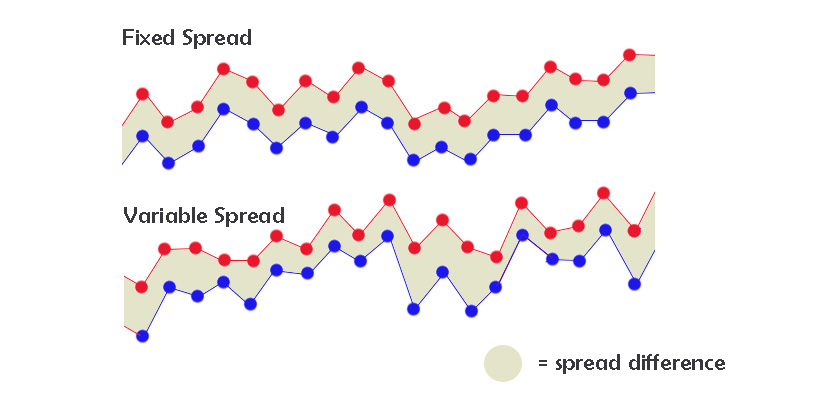
Most accounts today have a floating spread, but you will still see both types:
| Fixed | Floating | |
|---|---|---|
| Size | Set by the broker, the same in normal conditions | Changes all the time with the market |
| In quiet hours | Usually wider than floating | Can be very narrow |
| Around news | You may get requotes or changed terms | Can widen sharply |
| Best for | Knowing the cost in advance | Lower cost in liquid hours |
A fixed spread isn't a promise that holds in every market. It has no connection with how much capital you need, and it doesn't remove the risk of a fast market: check your broker's terms for what happens around news.
When Spreads Widen
The spread reflects how easy it is to trade at that moment. It is usually narrower on liquid pairs when many traders are active, and wider when they aren't:
- Time of day. The busiest hours are usually when London and New York overlap, roughly 13:00–17:00 London time. Spreads are usually narrower then.
- Rollover. Around the end of the trading day liquidity drops, and spreads can widen for a while.
- News. Around major releases, such as interest rate decisions, prices move quickly and spreads tend to widen. See Fundamental Analysis in Forex.
- The pair. Less traded pairs usually have wider spreads than EUR/USD or USD/JPY.
- The weekend open. The market is thin when it reopens, and the first prices can be far from Friday's close.
A wider spread does more than raise the cost of a new trade. MetaTrader checks a buy's stop against the bid and a sell's stop against the ask, so a sudden widening can trigger a sell's stop before the bid line on the chart gets there (see Short Selling in Forex). It can also lower your equity while trades are open, because they are valued at the worse price. If your margin is already tight, that moves you closer to a margin call or stop out, and your broker sets those levels (see What Is Leverage in Forex?).
The spread is also different from slippage. You can see the spread before you trade, while slippage only shows up after the fill. Both are explained in Slippage and Order Execution in Forex.
How to See and Compare Spreads
In MT4, right-click the Market Watch window and turn on the Spread column. To see the buy price on the chart, open the chart properties (F8) and tick Show Ask line, because the chart shows only the bid by default.
To compare accounts, count the full cost per trade. Commission belongs in the sum, because a low spread can come with one. Here is an example with invented terms, at 0.10 lot of EUR/USD:
| Account | Spread | Commission | Total |
|---|---|---|---|
| A | 1.2 pips ($1.20) | None | $1.20 |
| B | 0.2 pips ($0.20) | $7 per lot, round trip ($0.70) | $0.90 |
Advertised figures such as “from 0.0 pips” describe the best moment, not your average. Note the spread several times a day, in the hours you actually trade, on a demo account or a small live one. Then compare the averages. Cost isn't the only test either: our guide on how to choose a forex broker covers regulation and the other checks.
Can You Trade the Spread?
You'll find advice on “spread trading strategies”, but for a retail trader the spread is a cost to manage, not a source of profit. A spread indicator shows you the cost. It doesn't tell you where the price will go. Three habits do most of the work:
- Trade liquid pairs in their active hours.
- Avoid opening trades in the minutes around big news unless your plan is built for it.
- Make sure your target is large compared with the total cost of the trade.
FAQ
What is a good spread in forex?
There is no single figure, because it depends on the pair, the hour and the account. Judge it against your own trades: a 1.2-pip spread takes 4% of a 30-pip target but 24% of a 5-pip target. Compare the total cost including commission, measured in the hours you trade.
Do you pay the spread twice?
No, you pay it once per trade. A buy opens at the ask and closes at the bid, so opening and closing together cost one spread. If the spread is wider when you close, the cost is higher than it looked when you opened.
Why does MetaTrader show a spread of 12 when it is 1.2 pips?
MetaTrader counts in points, the smallest price step. On a 5-digit quote one point is a tenth of a pip, so 12 points equal 1.2 pips.
Why do spreads widen at night and around news?
Fewer orders are near the current price, so prices are less certain and providers quote wider. It usually happens around rollover, around major releases, on less traded pairs and at the weekend open.
Is a zero spread account free to trade on?
Usually not. Accounts with very low spreads tend to charge a commission, and the spread can still widen in thin markets. Add the spread and the commission together, and compare that total.
The Bottom Line
- The spread is ask minus bid, and you pay it once per trade.
- In money it is pips × pip value × lots: 1.2 pips on 0.10 lot of EUR/USD is $1.20.
- MetaTrader shows points, so 12 means 1.2 pips.
- Spreads usually widen around rollover, news and thin markets.
- Compare the total cost with commission, not the advertised minimum.
Next, see how costs fit into a plan in Forex Risk Management, or start from the beginning with our step-by-step guide to start trading.
This article is educational and is not investment advice. The prices and account terms are illustrative. Trading leveraged products involves risk of loss.