A pip is the standard unit of price movement in forex: 0.0001 for most currency pairs and 0.01 for pairs with the Japanese yen. If EUR/USD moves from 1.0852 to 1.0853, it has moved 1 pip. The money value of that pip depends on your position size: on EUR/USD it is $10 for 1 standard lot, $1 for 0.10 lot and $0.10 for 0.01 lot.
Knowing pips lets you measure a price move, set a stop loss in clear units and work out how much a trade can cost you before you open it. Below we cover what a pip is, how to calculate its value and how to use it to size a position.
What Is a Pip?
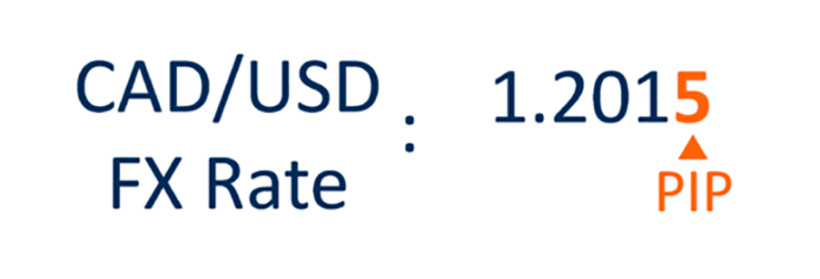
Pip stands for "percentage in point" (sometimes "price interest point"). It is a fixed step of price, not a percentage:
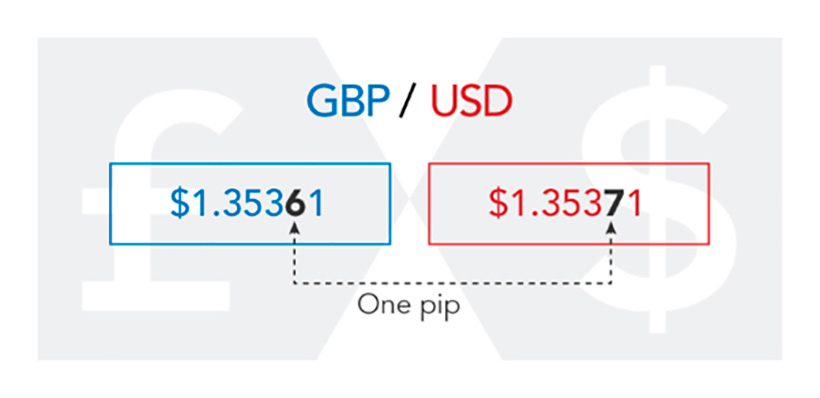
- Most pairs (EUR/USD, GBP/USD, USD/CAD, AUD/USD…): 1 pip = 0.0001, the fourth digit after the decimal point.
- Yen pairs (USD/JPY, EUR/JPY, GBP/JPY…): 1 pip = 0.01, the second digit after the decimal point.
For example, EUR/USD moving from 1.0852 to 1.0872 is a move of 20 pips. USD/JPY moving from 150.20 to 150.45 is a move of 25 pips.
A pip is not the same as a basis point. A basis point is a relative value (0.01%), while a pip is an absolute step in the quote.
Pip and Pipette: Why Quotes Have 5 Digits
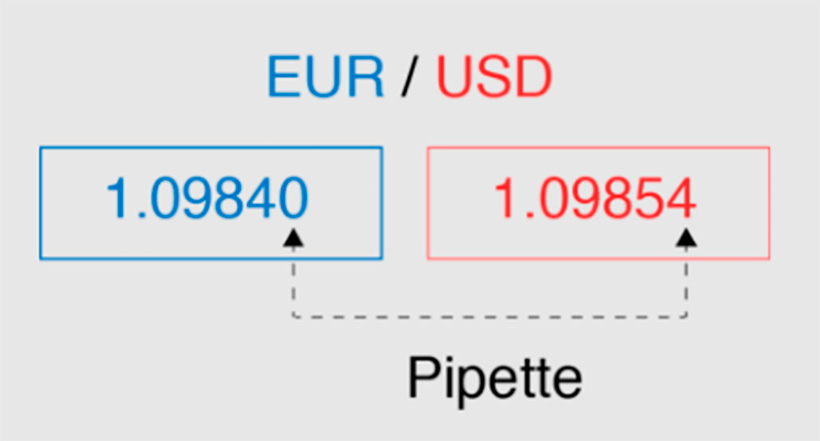
Most brokers quote prices with one extra digit: 5 decimal places for most pairs (1.08525) and 3 for yen pairs (150.205). That last digit is a pipette, or fractional pip, equal to one tenth of a pip.
So in the quote 1.08525 the pip is the fourth decimal digit (2), and the fifth digit (5) is pipettes. A move from 1.08525 to 1.08535 is 1 pip, or 10 pipettes.
Note for MetaTrader users: in MT4 and MT5 the "points" setting means the smallest price step, which on a 5-digit quote is a pipette. A stop loss of 20 pips equals 200 points. If you enter 20 points by mistake, your stop will be ten times closer than you intended.
Why Pips Matter
Pips give you one common unit for everything that happens on the chart:
- Spread. The difference between the bid and ask price is quoted in pips. A 1.2-pip spread on 0.10 lot of EUR/USD costs you $1.20 when you open the trade. More on this in our article Spread in Forex: What It Means and How to Calculate It.
- Stop loss and take profit. You set them as a distance in pips from your entry price.
- Result of a trade. Profit or loss = number of pips × pip value. A 1-pip move against you costs exactly the same as a 1-pip move in your favor earns.
- Position size. Once you know the pip value, you can choose a lot size that keeps a possible loss within your limit.
How to Calculate Pip Value
The money value of one pip depends on three things: the currency pair, your position size and, for some pairs, the current exchange rate. A standard lot is 100,000 units of the base currency, 0.10 lot (mini) is 10,000 units and 0.01 lot (micro) is 1,000 units.
Pairs where USD is the quote currency (EUR/USD, GBP/USD…)
For a USD account this is the simplest case: pip value = position size in units × 0.0001, and the result is already in US dollars.
10,000 × 0.0001 = $1
So if you buy 10,000 EUR/USD (0.10 lot) and the price rises by 1 pip, your profit is $1. If it falls by 1 pip, your loss is the same $1.
| Position size (EUR/USD) | Units | Value of 1 pip | Value of 20 pips |
|---|---|---|---|
| 1 lot (standard) | 100,000 | $10 | $200 |
| 0.10 lot (mini) | 10,000 | $1 | $20 |
| 0.01 lot (micro) | 1,000 | $0.10 | $2 |
The same values apply to GBP/USD, AUD/USD, NZD/USD and other pairs where USD is the second currency.
Pairs where USD is the base currency (USD/CAD, USD/CHF…)
Here a pip is measured in the quote currency, so to get its value in US dollars you divide by the current rate:
Pip value = 0.0001 ÷ exchange rate × position size
Example for USD/CAD at 1.2827 with 1 standard lot (100,000 USD):
0.0001 ÷ 1.2827 × 100,000 ≈ $7.80
In other words, 1 pip on USD/CAD is worth 10 Canadian dollars per lot, which at 1.2827 is about $7.80. If you buy 1 lot of USD/CAD at 1.2827 and close at 1.2828, the result is about +$7.80. Because the rate keeps changing, this pip value changes slightly too.
Yen pairs (USD/JPY, EUR/JPY…)
For yen pairs a pip is 0.01, so the formula uses 0.01 instead of 0.0001:
Pip value = 0.01 ÷ exchange rate × position size
Example for EUR/JPY at 132.62 with 1 standard lot (100,000 EUR):
0.01 ÷ 132.62 × 100,000 ≈ €7.54
The result is in euros, the base currency of the pair. In yen, 1 pip on 1 lot is always 1,000 JPY. If your account is in US dollars, the platform converts this amount at the current EUR/USD or USD/JPY rate.
You do not have to do these calculations by hand every time: MetaTrader shows the result of an open trade in your account currency, and a calculator gives you the pip value for any pair in seconds.
Example: Position Size From a Stop in Pips
Pips are most useful when you plan a trade. A common approach is to risk a fixed share of your balance on each trade:
- Balance: $2,000
- Risk per trade: 1% = $20
- Stop loss: 20 pips on EUR/USD
$20 ÷ 20 pips = $1 per pip → 0.10 lot
If the stop is hit, the loss is about $20, or 1% of the balance. With a 40-pip stop, the same $20 risk would mean 0.05 lot. You can check any pair and account size with our lot size calculator.
Keep in mind that a stop loss limits a loss but does not guarantee the exact exit price: during fast moves or price gaps the trade can close a few pips further away.
The Bottom Line
- A pip is 0.0001 for most pairs and 0.01 for yen pairs. The fifth (or third) digit in a quote is a pipette, one tenth of a pip.
- On EUR/USD 1 pip is worth $10 for 1 lot, $1 for 0.10 lot and $0.10 for 0.01 lot.
- For other pairs, pip value depends on the exchange rate and is calculated with the formulas above.
- Knowing the pip value lets you see what a trade can cost you before you open it and pick a position size that fits your risk.
If you are just getting started, read our step-by-step guide to start trading.